
AUTOSAR structure with semi-AUTOSAR speed — verified on the wire.
Real ECU programs are stacks, not single modules. This project boots deterministically, communicates, diagnoses itself, persists data, protects messages, survives bus faults, and reflashes in the field and at EOL.
We use a Semi-AUTOSAR architecture that keeps integration complexity manageable while matching production-like behavior on CAN, UDS, and security.
Technical Overview
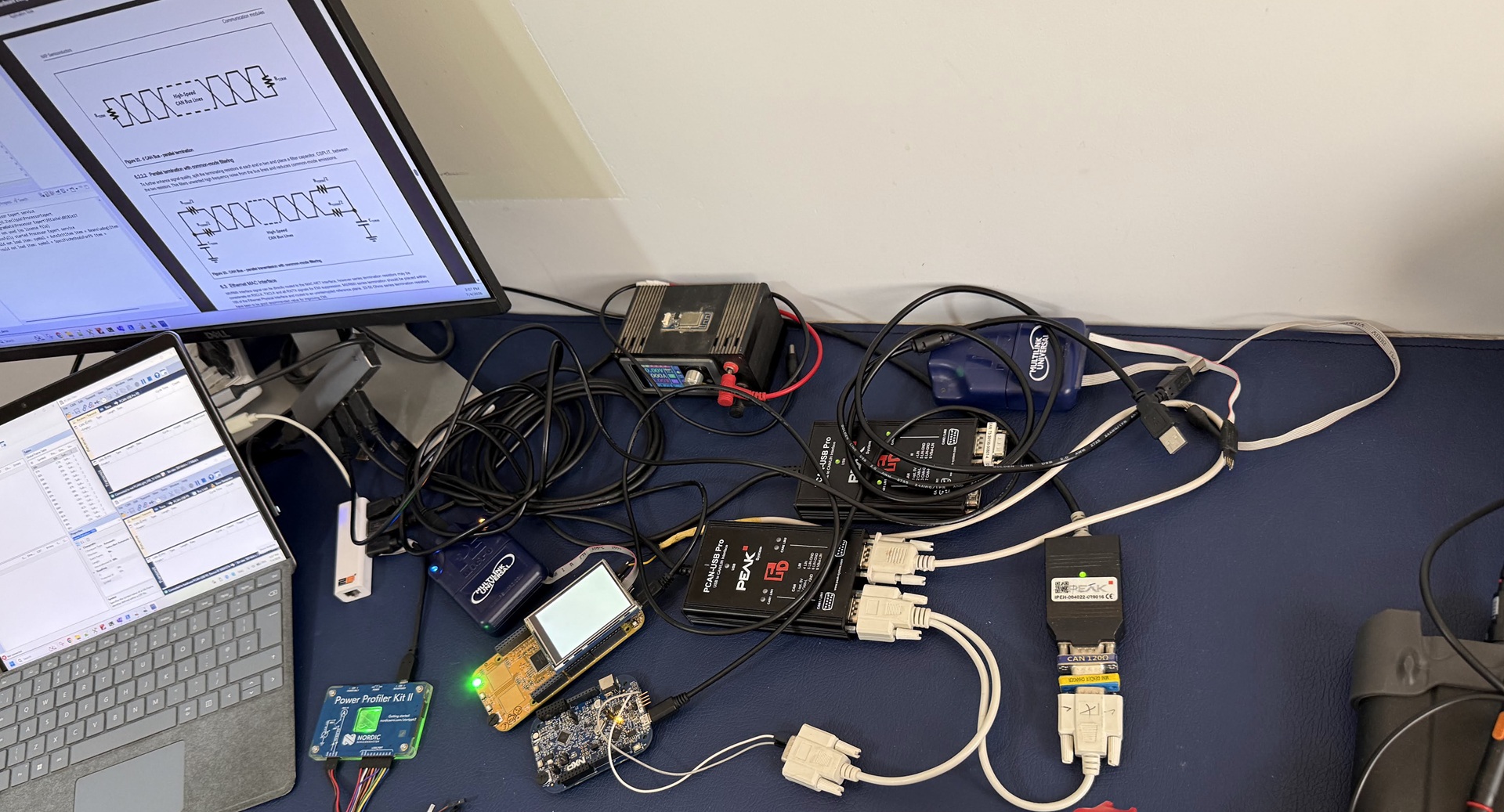
Hardware: S32K144EVB, debug access, CAN-FD interface, and oscilloscope measurement.
Built with DBC/ARXML tools, SemSAR module generators, bootloader generator, SecOC tooling, rest-bus test, and flashing tool.
Host simulation passes 49/49 internal functional checks and 36/36 internal bootloader checks before the same sources are flashed to hardware and re-tested with automated bus validation.
Stack layers demonstrated
- MCAL — Can, Eep, Fls, Wdg, Adc, Port
- Communication — CanIf, CanTp, PduR, Com
- Diagnostics — Dcm, Dem with UDS and DTC management
- Memory — NvM, Fee, MemIf, Eep
- Security — Csm, CryIf, Crypto, SecOC, E2E, Crc
- Network management — CanNm, ComM, Nm
- Supervision — WdgM, WdgIf, Wdg
- Mode management — EcuM, BswM
- Application — RTE and SWC (lamp controller)
- Bootloader — UDS CAN FBL with CRC32 and boot decision
Validation approach
- Host simulation: 49/49 internal functional checks, 36/36 internal bootloader checks
- Hardware bench: same sources on several platforms with automated CAN-FD bus validation
- UDS reprogramming against on-chip CAN bootloader
- SecOC tamper rejection demonstration
- Identical test campaign from simulation to hardware
What This Demonstrates
- Complete Semi-AUTOSAR ECU on several platforms
- SemSAR module configuration generators
- UDS CAN bootloader
- SecOC and E2E message protection
- Host simulation validation before hardware
- Automated bus validation on target
- Simulation-first ECU delivery workflow